
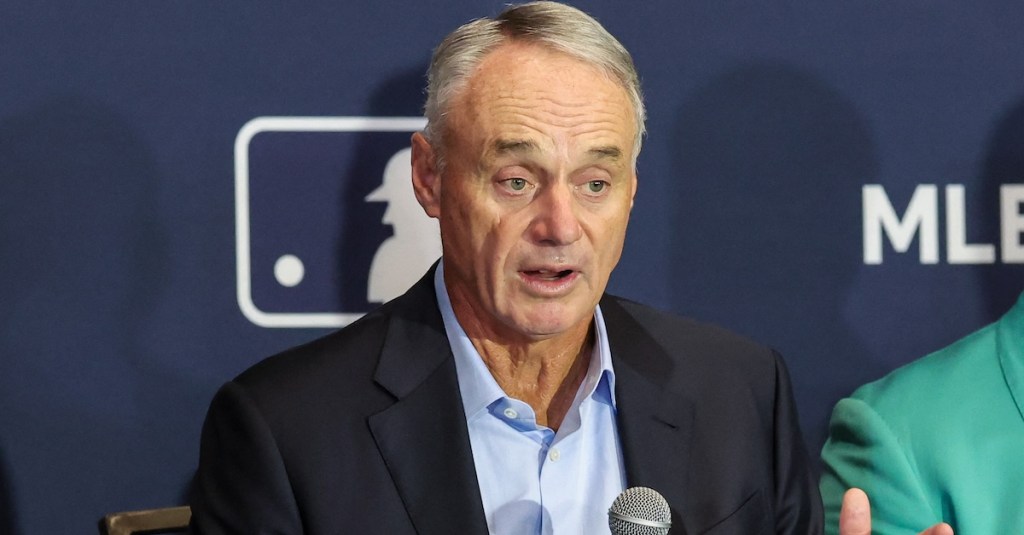
Major League Baseball is making another push to introduce a salary cap, but the latest proposal from ownership isn’t doing much to convince the players’ union.
With the current collective bargaining agreement set to expire on December 1, 2026, MLB has made a significant adjustment to its proposal, pushing the implementation of a hard salary cap and spending floor from 2027 to 2028. The league has also increased the proposed financial limits, hoping the changes will help move negotiations forward.
However, despite the adjustments, the biggest obstacle remains the same: the MLB Players Association wants nothing to do with a salary cap.
MLB Increases Its Salary Cap and Spending Floor
Under the league’s latest proposal, MLB would introduce a hard salary cap of $258.2 million and a salary floor of $180.2 million beginning with the 2028 season.
That’s an increase from the league’s previous proposal, which called for a $245.3 million cap and a $171.2 million floor beginning in 2027.
The additional year would give teams more time to adjust their payrolls and financial commitments before operating under the proposed system.
Based on 2026 luxury-tax payroll figures, the changes would have a significant impact across the league.
Twelve teams would need to increase their payrolls by a combined $636 million to reach the proposed spending floor. That group includes the Milwaukee Brewers, Tampa Bay Rays, Miami Marlins and Washington Nationals.
On the other side, eight teams would need to reduce their payrolls by a combined $528 million to get below the proposed salary cap.
Among those teams are the Los Angeles Dodgers, New York Mets, New York Yankees and Philadelphia Phillies.
The Dodgers would be particularly affected after finishing 2026 with a luxury-tax payroll of approximately $433 million.
In other words, some of baseball’s biggest spenders would have to significantly change how they build their rosters, while several lower-spending organizations would be required to invest considerably more in their major league teams.
What Would Players Get in Return?
MLB isn’t simply proposing a salary cap without offering concessions to the players.
The league has indicated that several player-friendly changes would take effect in 2027, even if the salary cap itself doesn’t arrive until 2028.
Among the proposed changes:
- Earlier free agency: Players who are at least 30 years old could become eligible for free agency after five years of service instead of the current six-year requirement.
- Higher minimum salaries: The minimum salary would increase, reaching $1 million for players with at least two years of service.
- Larger pre-arbitration bonus pool: The bonus pool would increase by 30%, from $50 million to $65 million in 2027.
- Elimination of qualifying offers: Teams would no longer have to surrender draft picks for signing certain free agents who received qualifying offers.
- Roster changes: MLB would reduce the number of times a player could be optioned during a season, among other changes designed to reduce roster movement.
From the league’s perspective, these adjustments would provide players with additional financial benefits while creating a more competitive economic structure.
The players’ union, however, believes the concessions don’t come close to addressing its concerns.
The MLBPA Isn’t Buying It
The MLBPA has remained firmly opposed to implementing a salary cap, and moving the proposed start date back one year hasn’t changed its position.
The union argues that a hard cap would artificially limit player salaries, restrict player movement and potentially threaten guaranteed contracts.
It also believes the proposed system could negatively affect middle-class players while creating a situation where players are competing against one another for a limited pool of money.
The union has also raised concerns about the potential impact on domestic and international amateur players and the draft system.
MLBPA interim executive director Bruce Meyer has made it clear that the disagreement isn’t simply about giving smaller-market teams a better chance to compete.
The union believes ownership is attempting to introduce a system that would suppress player compensation and give teams greater control over spending.
This is a disagreement that goes back decades. MLB has not formally proposed a salary cap since the labor negotiations that preceded the devastating 1994 strike.
A Potential Lockout Is Looming
The timing of these negotiations is becoming increasingly important.
MLB’s current collective bargaining agreement expires on December 1, 2026, and another lockout is widely expected once the agreement expires.
If a lockout occurs, all player transactions would come to a halt until a new agreement is reached.
That would mean no free-agent signings, trades or other roster transactions during the work stoppage.
With the 2026-27 offseason already underway, teams are facing significant uncertainty about how aggressively they should pursue free agents and construct their rosters.
Pushing the salary cap implementation to 2028 gives organizations additional time to prepare, but it doesn’t solve the fundamental disagreement between the league and the union.
What This Means for Baseball
At the center of this entire debate is the question of how much control MLB owners should have over team spending.
Owners argue that a salary cap and floor would create greater competitive balance by preventing wealthy organizations from dramatically outspending smaller-market clubs.
The players argue that a salary cap would limit their earning potential and fundamentally change the economics of the sport.
There are legitimate questions about competitive balance in baseball. Teams like the Dodgers have demonstrated how aggressive spending can help build championship-caliber rosters, while other organizations have faced criticism for consistently operating near the bottom of the league in payroll.
But introducing a salary cap doesn’t automatically guarantee that every team will spend money intelligently or compete for a championship.
A spending floor could force lower-spending organizations to invest more in their rosters, which would be a positive for fans. However, a hard ceiling would also prevent high-revenue teams from spending beyond a predetermined limit, regardless of their financial resources.
Ultimately, MLB has made some adjustments to its proposal, but the biggest sticking point hasn’t changed.
The owners want a salary cap. The players don’t want one.
With the December 1 deadline approaching, baseball could be heading toward another contentious labor battle, and the possibility of a prolonged work stoppage is becoming increasingly difficult to ignore.
The question isn’t just whether MLB can reach a new agreement. It’s whether the two sides can do so without jeopardizing another baseball season.




Leave a Reply