
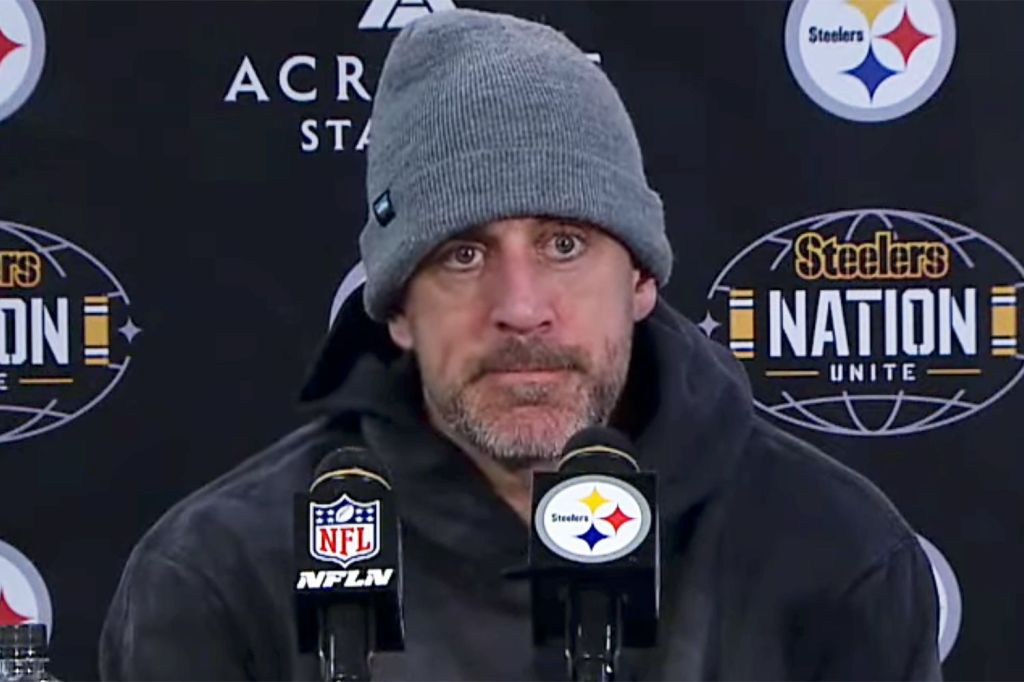
Aaron Rodgers may be one of the greatest quarterbacks to ever spin a football, but if this really was his final NFL press conference, he made sure to go out the way he usually does: by lighting a match, tossing it into a puddle of gasoline, and then critiquing the media for noticing the fire.
Fresh off a 30–6 Wild Card drubbing at the hands of the Houston Texans, a game in which the Steelers’ offense failed to score a single touchdown — Rodgers turned the postgame spotlight away from his stat line and toward the state of NFL coaching discourse. The Steelers were bounced, Rodgers was battered, and yet somehow the real victims, according to Rodgers, were Mike Tomlin and Matt LaFleur.
Rodgers took issue with the idea that either coach could be considered “on the hot seat,” lamenting how the league has changed during his 21-year career.
“When I first got into the league, there wouldn’t be conversations about whether those guys were ‘on the hot seat,’” Rodgers said, before unloading on “Twitter experts” and TV analysts who “make it seem like they know what the hell they’re talking about.”
Less than 24 hours later, Tomlin stepped down after 19 seasons in Pittsburgh. Timing, as they say, is undefeated.
The problem with Rodgers’ argument wasn’t just the irony, it was also the accuracy. NFL writers were quick to point out that coaches have absolutely been fired under similar circumstances throughout Rodgers’ entire career. Marty Schottenheimer was famously canned after a 14–2 season and a No. 1 seed. Lovie Smith got the boot after a 10–6 year. Andy Reid was pushed out in Philadelphia before resurrecting his career in Kansas City. Even Mike McCarthy, Rodgers’ own former coach was fired in Green Bay mid-season.
In other words, this wasn’t some new-age Twitter invention. This was the NFL being the NFL.
Then came the part where Rodgers criticized non-experts for shaping narratives, which went over about as smoothly as a fake spike. Social media wasted no time pointing out the hypocrisy from a quarterback who has spent years confidently opining on topics well outside the hash marks.
“So unless people are subject-matter experts, we shouldn’t listen to them?” one viral tweet asked. “What a wild concept and not ironic at all coming from Aaron Rodgers.”
Others were less subtle, referencing Rodgers’ past commentary on vaccines, COVID, Epstein, and assorted conspiracy adjacent topics. “Doctors say the same thing about athletes talking about vaccines,” one user shot back. Touché.
Lost in all the discourse was the actual football, which didn’t exactly help Rodgers’ case. In what could be his final NFL game, he completed 17 of 33 passes for 146 yards, threw no touchdowns, and tossed a pick-six for good measure. He was also sacked four times, which felt appropriate given how often his comments get hit from all angles.
If this was the end for Aaron Rodgers, it was a fitting finale: no touchdowns, plenty of takes, and one last reminder that nobody generates headlines quite like No. 12, even when the scoreboard says otherwise.


 Home of Sheffield Shuffler
Leave a comment